Defense Advanced Research Projects Agency (DARPA) recently announced a new program that aims to improve military communications at a millimeter (Mm) wave, with digital phased […]
The post Military Communications Market Prophesied to Grow at a Faster Pace by 2018-2028 first appeared on Market Research Blog.
Military Communications Sector Expected to Accelerate Growth by 2028
Defense Advanced Research Projects Agency (DARPA) recently announced a new program that aims to improve military communications at a millimeter (Mm) wave, with digital phased arrays. The current millimeter wave system, which is platform-specific and inconvenient, lacks interoperability and sufficient security. To make it broadly applicable with improved security attributes, researchers are expected to face multiple technical challenges such as wideband frequency coverage, mesh networking, and precision beam pointing. DARPA’s newly announced program is supposed to create a multi-beam to operate at 18-50 GHz for optimum security in communications among multiple military platforms. Recent findings highlight growing interest in the broader use of the Mm wave frequency band to achieve enhanced security in communications occurring on small mobile platforms. Advances in Mm wave, multi-beam phased arrays, and other technologies such as digital radio are foreseen to drive transformation of networked mobile platforms, which will eventually impact communication.
Demand in Command & Control to Persist; Land Force to Register Maximum Use
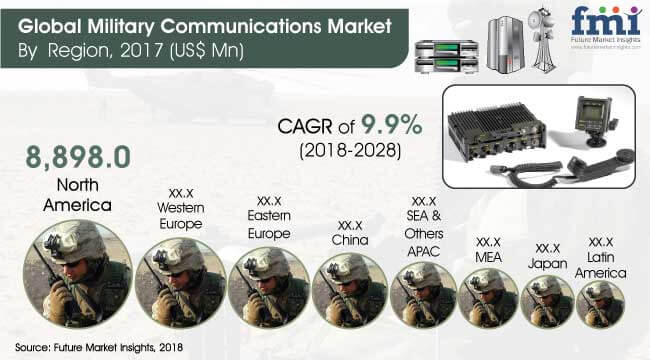
Growing demand for multi-intelligence ground systems, and large-scale, high-performance data and signal processing is anticipated to drive applications of military communications in Command & Control, followed by in Intelligence, Surveillance, and Reconnaissance (ISR). In terms of end use, the adoption of military communications solutions by Land Force will remain the maximum, compared to Air Force and Naval Force. Military communications will continue to play a pivotal role in warfare, with numerous technological advancements and potential applications. As indicated by a recently released research report by Future Market Insights, the global military communications market is expected to attain a value exceeding US$ 68 Billion by the end of 2028, witnessing healthy expansion at a CAGR of 9.9% over a 10-year projection period, 2018-2028.
2.5X Growth Predicted for Satellite Communication Systems, Strongly Backed by Rapidly Improving Satellite Communication Infrastructure
For more than four decades, satellite systems continue to be on the leading edge of military communications. However, it is most likely that a range of cutting-edge terrestrial communication technologies such as smart phone will outweigh the capabilities of satellite communication technology in upcoming years. Researchers and technology experts are currently exploring various ways of introducing the satellite coverage technology to terrestrial communication systems used commercially.
Fixed satellite service and mobile satellite service providers can create abundant opportunities for the development of advanced military communication equipment. Furthermore, collaborations involving satellite communication service providers can potentially create a heap of new revenue generation channels for advanced and connected military communication solution providers. The revenue through adoption of SCS (satellite communication systems) is predicted to grow 2.5X during 2018-2028.
For More Details, Ask Analyst @ https://www.futuremarketinsights.com/ask-question/rep-gb-627
The military is rapidly going ‘wireless’, specifically for sensor-driven security, environmental control, tactical applications, and yard management. Military wireless communication systems are often designed to operate in harsh environments, where the equipment is exposed to stringent environmental factors. Furthermore, these systems also provide high-level security to protect sensitive data critical for national security and tactical operations. Swift development of commercial wireless communication technology has surged the interest of the military community in leveraging commercial technologies for addressing incessant communication needs.
The post Military Communications Market Prophesied to Grow at a Faster Pace by 2018-2028 first appeared on Market Research Blog.