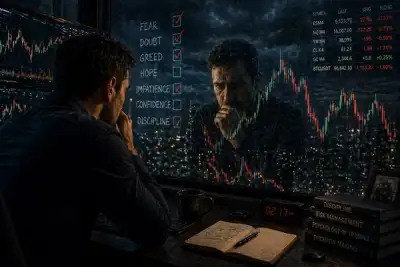
There is a widely accepted belief in trading:
The more you analyze, the better you trade.
More indicators. More data. More confirmation. More certainty.
It sounds logical. It feels responsible. It even appears disciplined.
But beneath this assumption lies a subtle illusion—one that many traders only recognize after experience has already taught them the hard way.
Because in modern markets, more analysis does not always produce better decisions.
Sometimes, it produces the opposite.
The Rise of Analytical Overload
Trading has evolved dramatically.
Today’s traders have access to:
Real-time data streams
Advanced charting tools
Dozens of indicators
Automated alerts and signals
What was once limited is now abundant.
And yet, this abundance has introduced a new challenge: analytical overload.
Behavioral research shows that excessive information can overwhelm decision-making capacity, making it harder to identify relevant signals and increasing the likelihood of errors ( ijrar.org )
In trading, this translates into something counterintuitive:
The more tools you use, the harder it becomes to decide.
When Confirmation Becomes Confusion
Many traders seek confirmation before acting.
They wait for:
Indicator alignment
Multiple signals
Strong validation
This approach appears cautious—but it often leads to hesitation.
Why?
Because every additional layer of confirmation introduces:
More variables
More potential contradictions
More uncertainty
Behavioral finance shows that investors are influenced by cognitive biases that distort how they interpret information, especially when faced with complexity ( Atlantis Press )
Instead of clarity, confirmation can create confusion.
The Hidden Cost of Overthinking
Over-analysis does not just slow decisions—it changes how they are made.
When traders analyze excessively, they often:
Second-guess valid setups
Delay entries until opportunities pass
Exit trades prematurely due to conflicting signals
This is not a lack of knowledge.
It is a result of too much processing.
Studies in decision-making highlight that individuals often struggle when faced with multiple competing options, sometimes avoiding decisions altogether when complexity increases ( Wikipedia )
In trading, this leads to missed opportunities.
The Difference Between Information and Insight
Information is not the same as insight.
Information is raw data.
Insight is the ability to interpret and act on it.
The problem is that more information does not automatically improve insight.
In fact, it can dilute it.
Traders often assume that:
More indicators = stronger signal
More data = better decision
More confirmation = lower risk
But in reality:
More inputs can reduce clarity.
Why Simplicity Is Harder Than Complexity
Simple strategies often feel uncomfortable.
They lack the reassurance of multiple confirmations. They require trust in fewer signals.
But simplicity has an advantage:
Faster interpretation
Clearer decisions
Reduced cognitive load
Complex strategies, on the other hand, may feel safer—but they often delay action.
And in markets, delay has a cost.
The Role of Cognitive Bias
Overanalysis is often driven by cognitive bias.
Some of the most common include:
Confirmation bias: Seeking additional data to support an existing view
Overconfidence: Believing more analysis guarantees accuracy
Loss aversion: Avoiding decisions due to fear of being wrong
Behavioral finance research confirms that these biases significantly influence financial decisions, often leading to irrational outcomes ( Allied Business Academies )
This means that overanalysis is not just technical—it is psychological.
When Less Becomes More
Experienced traders often reach a surprising conclusion:
They begin to simplify.
Not because they know less—but because they understand more.
They focus on:
Key signals
Clear setups
Defined rules
This does not reduce risk.
But it improves decision quality.
Clarity Through Constraint
One way to improve trading decisions is through constraint.
Limiting:
The number of indicators
The amount of data considered
The number of strategies used
This forces clarity.
It reduces noise.
It simplifies interpretation.
The Balance Between Analysis and Action
Trading requires both analysis and action.
Too little analysis leads to impulsive decisions.
Too much analysis leads to inaction.
The goal is balance.
And that balance is not fixed—it is developed through experience.
The Illusion That Changes Everything
The clarity illusion is subtle.
It convinces traders that more effort leads to better outcomes.
But in many cases:
Clarity comes not from adding more—but from removing what is unnecessary.
Because in trading, the challenge is not finding more information.
It is knowing when you already have enough.