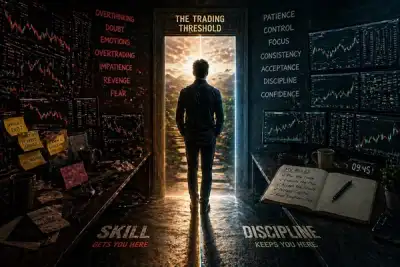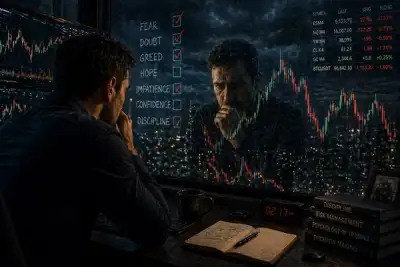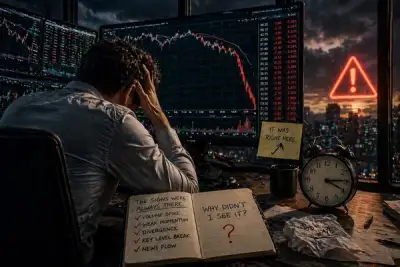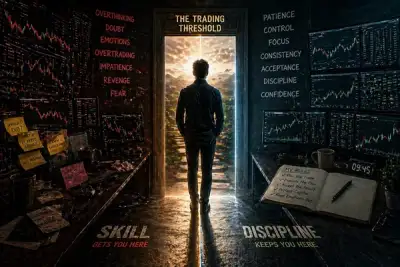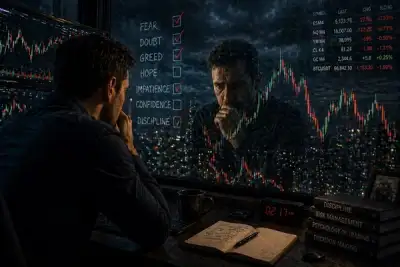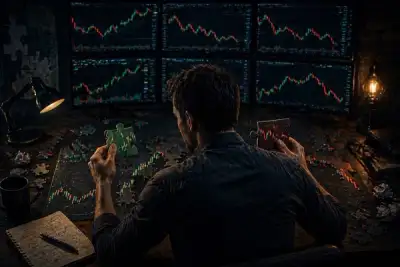

In trading, attention gravitates toward action.
Entry points. Exit strategies. Price levels. Indicators.
These are the moments traders focus on—the visible decisions that define performance.
But there is another moment, quieter and far less discussed, that often determines outcomes long before a trade is placed.
It is the moment of preparation.
And in many cases, it matters more than the trade itself.
The Invisible Phase of Trading
Before any trade is executed, there is a phase that receives little attention:
Reviewing market conditions
Assessing risk
Defining expectations
Preparing mentally
This phase is not dramatic. It does not produce immediate results. But it shapes everything that follows.
Research in trading psychology suggests that preparation significantly influences decision quality, particularly in high-pressure environments where rapid decisions are required ( corporatefinanceinstitute.com ).
Why Action Feels More Important Than Preparation
There is a natural bias toward action.
Placing a trade feels productive. Watching markets move feels engaging. Responding quickly feels decisive.
Preparation, by contrast, feels passive.
But this perception is misleading.
Because in trading:
Action reflects decisions—but preparation shapes them.
Without preparation, decisions are often reactive. With preparation, they become intentional.
The Cost of Skipping Preparation
When preparation is neglected, several patterns emerge:
Trades are based on impulse rather than analysis
Risk is not fully considered
Expectations are unclear
Emotional reactions increase
These patterns are not always obvious at first. In fact, trades made without preparation can still be profitable.
But over time, inconsistency begins to appear.
Behavioral research highlights that decision-making under uncertainty becomes less reliable when individuals act without structured preparation, increasing the likelihood of errors ( britannica.com ).
Clarity Before Complexity
Modern trading environments are complex.
Multiple indicators, real-time data, and constant market updates create a sense that more analysis leads to better decisions.
But preparation is not about adding complexity.
It is about creating clarity.
This includes asking simple but critical questions:
What is the current market condition?
What is the risk of this trade?
What outcome am I prepared for?
These questions do not predict the market.
But they align the trader with it.
The Role of Mental Readiness
Preparation is not only analytical—it is psychological.
Trading involves uncertainty, risk, and emotional pressure. Entering a trade without mental readiness increases the likelihood of:
Overreacting to price movements
Exiting too early or too late
Deviating from strategy
Studies show that emotional regulation plays a key role in financial decision-making, particularly in volatile environments ( sciencedirect.com ).
Preparation provides a buffer against these reactions.
From Reaction to Intention
Without preparation, trading becomes reactive.
Traders respond to price movements, news, and short-term signals without a clear framework.
With preparation, trading shifts:
From reaction to intention
From impulse to structure
From uncertainty to awareness
This shift does not eliminate risk.
But it improves how risk is managed.
Why Preparation Improves Consistency
Consistency in trading is often misunderstood.
It is not about winning every trade.
It is about making decisions in a repeatable, structured way.
Preparation contributes to consistency by:
Standardizing decision-making
Reducing emotional influence
Aligning trades with strategy
Over time, this creates more stable performance.
The Quiet Discipline That Builds Over Time
Preparation is not a one-time activity.
It is a habit.
And like any habit, its impact compounds over time.
Small improvements—such as clearer planning, better risk assessment, and improved focus—accumulate.
This compounding effect is subtle.
But it is powerful.
The Trade Before the Trade
In trading, the most important moment is often not the one that is visible.
It is the one that happens before.
The moment when decisions are shaped—not executed.
Because in the end:
The quality of your trades depends on the quality of your preparation.