Every trader begins with learning.
Charts. Indicators. Strategies. Market structure.
Skill becomes the focus.
And for a while, it works.
Improvement is visible. Decisions become sharper. Confidence grows.
But then something changes.
Progress slows.
Mistakes persist.
And a new realization begins to form:
Skill alone is no longer enough.
The Early Advantage of Skill
In the early stages, skill makes a significant difference.
Learning how to:
Read price action
Identify trends
Understand risk
These abilities create rapid improvement.
They reduce uncertainty and provide structure.
But this phase has limits.
The Plateau Most Traders Reach
At some point, many traders reach a plateau.
They know what to do—but struggle to do it consistently.
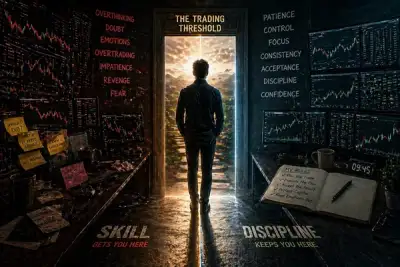
This is where the threshold appears.
The point where:
Knowledge stops improving results
Experience stops preventing mistakes
Skill stops being the main factor
And something else becomes more important.
The Shift from Skill to Discipline
Beyond this threshold, discipline becomes the defining factor.
Discipline is not about knowledge.
It is about behavior.
It involves:
Following rules consistently
Managing risk regardless of outcome
Avoiding impulsive decisions
Behavioral research shows that emotional and cognitive biases continue to influence trading decisions even among experienced participants ( Journal of Marketing & Social Research )
This explains why skill alone is not enough.
Why Knowing Isn’t the Same as Doing
One of the most frustrating aspects of trading is the gap between knowing and doing.
Traders may:
Understand risk management
Recognize valid setups
Know when to exit
Yet still:
Take excessive risk
Enter impulsively
Hold losing trades
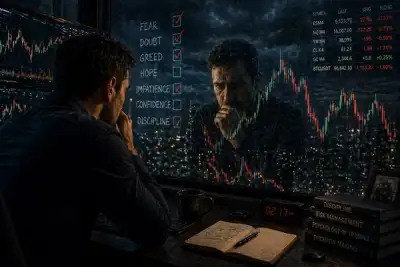
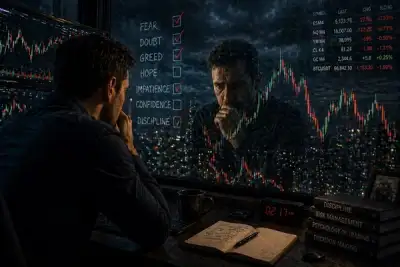
This gap exists because decisions are influenced by emotion.
The Role of Emotional Pressure
Trading is not just analytical—it is emotional.
Markets create:
Uncertainty
Pressure
Rapid feedback
Studies show that emotional responses—such as fear and excitement—are closely linked to trading performance and decision-making ( Massachusetts Institute of Technology )
This makes discipline essential.
Why Discipline Is Harder Than Skill
Skill can be learned.
Discipline must be maintained.
It requires:
Repetition
Self-control
Awareness
And unlike skill, it does not produce immediate rewards.
The Compounding Effect of Discipline
Discipline may seem subtle—but its impact compounds.
Over time, disciplined traders:
Reduce unnecessary losses
Improve consistency
Build confidence
This compounding effect is often invisible in the short term—but powerful in the long term.
The Turning Point in Trading
The moment traders recognize the importance of discipline is often a turning point.
It shifts focus from:
Finding better strategies
Learning more indicators
Seeking more signals
To:
Improving behavior
Managing emotions
Maintaining consistency
The Real Skill
At the highest level, trading is not about strategy.
It is about execution.
And execution depends on discipline.
Because the real skill in trading is not knowing what to do.
It is doing it—consistently.