When people think about technology in finance, they often picture what they can see—mobile banking apps, digital payments, or online trading platforms. But the most important transformation underway today is not happening at the surface.
When people think about technology in finance, they often picture what they can see—mobile banking apps, digital payments, or online trading platforms. But the most important transformation underway today is not happening at the surface.
It is happening underneath.
A new layer of technology—built on artificial intelligence, real-time data, and interconnected systems—is quietly redefining how financial services operate. It is not something users necessarily notice. Yet, it is fundamentally changing how money moves, how decisions are made, and how institutions compete.
This is not the next phase of digital transformation.
It is something deeper: the emergence of intelligent finance infrastructure.
From Digital to Intelligent Systems
The first wave of financial technology focused on digitization—moving processes from paper to digital formats.
The current wave is different.
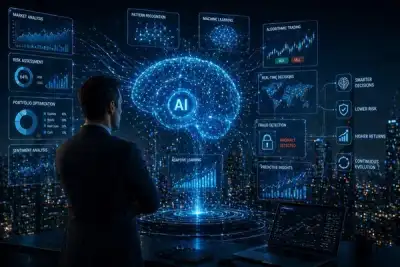
Financial institutions are shifting from digital systems to intelligent systems—platforms that can analyze, learn, and act in real time. Artificial intelligence, once considered experimental, is now embedded across core operations, from fraud detection to portfolio management ( MHO Blog ).
This shift is significant because it changes the role of technology.
Instead of simply executing instructions, systems are now capable of:
Identifying patterns
Predicting outcomes
Making recommendations—or even decisions
Finance is no longer just automated. It is becoming adaptive.
Real-Time Is Becoming the New Standard
One of the most important features of this new technology layer is speed.
Financial systems are moving toward real-time operations. Payments, risk analysis, and transaction monitoring are increasingly happening instantly rather than in batches.
Modern infrastructures now rely on continuous data processing, allowing institutions to monitor activity as it happens and respond immediately ( MHO Blog ).
This has wide-reaching implications:
Customers expect instant transactions
Businesses require real-time financial visibility
Risk must be detected and managed continuously
What was once considered advanced is quickly becoming the baseline.
AI Is Becoming the Operating Core
Artificial intelligence is not just another tool—it is becoming the core engine of financial systems.
Across the industry, AI is being used to:
Analyze vast datasets
Detect anomalies and fraud
Optimize customer experiences
Improve compliance and reporting
In fact, many financial institutions are embedding AI into nearly every operational layer, transforming how decisions are made and executed ( BizTech Magazine ).
This evolution is also changing roles within organizations.
Tasks that were once manual are being automated, allowing human professionals to focus on strategy, oversight, and innovation.
Data Is Driving Everything
If AI is the engine, data is the fuel.
Financial systems are generating and processing unprecedented volumes of data. This data is used to:
Personalize services
Predict customer behavior
Improve decision-making
Hyper-personalization—where services are tailored to individual users—is becoming a defining feature of modern finance ( Infomineo ).
However, this also introduces new challenges.
Data must be:
Accurate
Secure
Ethically managed
The more finance relies on data, the more critical these considerations become.
Embedded Finance Is Redefining Access
Another major shift is how financial services are delivered.
Finance is no longer confined to banks. Instead, it is being embedded into everyday platforms—shopping apps, digital services, and online ecosystems.
This means:
Payments happen within platforms
Lending is offered at the point of need
Financial services become part of user experiences
This trend, known as embedded finance, is expanding rapidly and reshaping how people interact with financial systems ( MHO Blog ).
The result is a system that is less visible—but more integrated into daily life.
The Infrastructure Revolution No One Talks About
While much attention is given to visible innovations, the real transformation is happening in infrastructure.
Financial institutions are moving away from legacy systems toward modern, cloud-based architectures that can support:
Real-time operations
AI-driven insights
Scalable digital services
Industry research shows that modernization of core systems is essential for enabling innovation and meeting new customer expectations ( Slalom ).
This shift is not glamorous—but it is critical.
Without modern infrastructure, none of the visible innovations would be possible.
Competition Is No Longer Traditional
Technology is also changing who financial institutions compete with.
Banks are no longer competing only with each other. They are competing with:
Fintech startups
Technology companies
Digital platforms
These new players bring speed, innovation, and customer-centric design.
As a result, traditional institutions are being pushed to evolve—not just to remain competitive, but to remain relevant.
The competitive landscape is expanding—and becoming more dynamic.
Cybersecurity and Trust Are More Important Than Ever
As financial systems become more digital and interconnected, security becomes critical.
Real-time systems, AI-driven processes, and data integration create new vulnerabilities. Cybersecurity is no longer just a technical issue—it is central to maintaining trust.
At the same time, trust remains the foundation of finance.
Institutions must ensure that systems are:
Secure
Reliable
Transparent
Without trust, even the most advanced technologies cannot succeed.
Human and Machine: A New Partnership
Despite the rise of automation, finance remains deeply human.
Technology is enhancing decision-making—but not replacing it.
The future of finance lies in collaboration between:
Human judgment
Machine intelligence
Research shows that human–AI collaboration is becoming a core strategy, where machines handle data processing and humans focus on insight and decision-making ( Slalom ).
This partnership allows for:
Better decisions
Faster responses
Greater adaptability
It is not about replacing people—it is about augmenting them.
A System That Is Becoming Smarter, Faster, and More Connected
Taken together, these trends point to a financial system that is:
Smarter, through AI and data
Faster, through real-time processing
More connected, through embedded and digital platforms
This transformation is not happening in isolation.
It is affecting:
Businesses seeking capital
Consumers managing finances
Institutions navigating risk
And it is doing so quietly—without dramatic disruption.
Why This Shift Matters
The significance of this technological evolution lies in its depth.
It does not just improve existing systems—it changes how they function.
It redefines:
Decision-making processes
Customer experiences
Competitive dynamics
And because it is happening gradually, it is easy to overlook.
But over time, these changes accumulate, creating a system that is fundamentally different.
Final Thoughts: The Future You’re Already Using
The most important technology shifts are not always visible.
They do not arrive suddenly. They do not always make headlines.
Instead, they integrate into systems, processes, and everyday experiences.
Today’s financial technology landscape reflects this reality:
Invisible, yet powerful
Complex, yet seamless
Evolving, yet already present
And perhaps the most important realization is this:
The future of finance is not something we are waiting for.
It is something we are already using—every single day—without even noticing it.