When people think about financial technology, they often imagine what’s visible—mobile banking apps, instant payments, or digital wallets. But the real transformation in finance is happening in places most people never see.
When people think about financial technology, they often imagine what’s visible—mobile banking apps, instant payments, or digital wallets. But the real transformation in finance is happening in places most people never see.
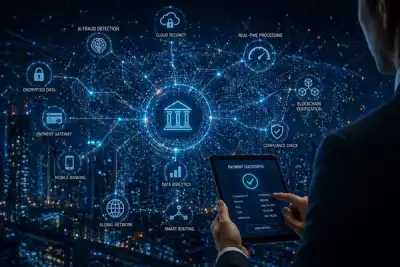
It’s happening in the systems that process data, power decisions, and move money across the global economy.
This invisible layer of technology—driven by artificial intelligence, cloud infrastructure, and real-time data—is quietly redefining how finance works. It is not a sudden disruption. It is a gradual but profound shift that is changing the logic of financial systems themselves.
And understanding this shift reveals where finance is truly heading.
From Digital Systems to Intelligent Systems
The financial industry has already gone through digitization. Processes that once relied on paper are now digital, and services that required physical presence are now online.
But the next phase is not digital—it is intelligent.
Financial systems are now evolving into environments that can analyze, learn, and adapt. Artificial intelligence is being integrated into core operations, transforming how institutions make decisions and interact with customers. ( MHO Blog )
This means systems can:
Detect fraud as it happens
Predict customer needs
Adjust risk models dynamically
Finance is no longer just processing information—it is interpreting it.
AI Is Becoming the Core Infrastructure
Artificial intelligence is no longer a niche innovation. It is becoming foundational.
Across the financial sector, AI is now embedded in everything from compliance and credit scoring to investment management and customer service. ( Forbes )
In fact, industry trends show that AI is shifting from experimental use cases to mission-critical infrastructure. ( MHO Blog )
This transition is significant because infrastructure defines capability.
Once AI becomes embedded at the core, it changes:
How fast decisions are made
How accurately risks are assessed
How efficiently systems operate
It also changes expectations—both internally and externally.
Real-Time Finance Is Redefining Speed
One of the most transformative developments is the move toward real-time systems.
Financial processes that once took hours or days are now happening instantly. Payments, settlements, and risk monitoring are increasingly executed in real time, supported by advanced digital infrastructure. ( Innowise )
This shift creates a new standard across the industry:
Customers expect immediate transactions
Businesses expect real-time financial insights
Institutions must respond without delay
Real-time finance is not just about speed—it is about responsiveness.
It allows financial systems to react to events as they happen, rather than after the fact.
Data Is Becoming the Central Asset
At the heart of this transformation is data.
Financial institutions are generating vast amounts of data—from transactions and customer interactions to market signals. This data is being used to:
Improve decision-making
Personalize services
Predict future trends
According to industry research, data-driven systems are becoming essential for delivering meaningful financial experiences and gaining a competitive edge. ( MX )
But data also introduces complexity.
Managing data effectively requires:
Strong governance frameworks
Advanced analytics capabilities
Robust security measures
The more finance relies on data, the more critical it becomes to manage it responsibly.
The Rise of Adaptive Financial Systems
One of the most important changes is the emergence of adaptive systems.
Traditional financial systems were static. They followed fixed rules and required manual updates.
Modern systems are dynamic.
They can:
Learn from past data
Adjust to new conditions
Optimize performance continuously
This adaptability is driven by AI, machine learning, and real-time analytics.
It allows financial institutions to operate more efficiently—and respond more effectively to change.
Embedded Finance Is Making Banking Invisible
Another major shift is the rise of embedded finance.
Financial services are no longer confined to banks. They are being integrated into everyday platforms—e-commerce sites, apps, and digital ecosystems.
This means:
Payments happen within platforms
Credit is offered at the point of purchase
Financial services become part of the user experience
This integration is enabled by APIs and open banking systems, which allow institutions to connect and share data securely. ( Finastra )
The result is a financial system that is less visible—but more pervasive.
Infrastructure Is the Real Battleground
While visible innovations attract attention, the real competition is happening at the infrastructure level.
Financial institutions are investing heavily in:
Cloud computing
Data platforms
Scalable digital architectures
These systems form the foundation for everything else.
According to global technology reports, more than 40% of the value organizations gain from digital technologies comes from their core platforms and infrastructure. ( KPMG Assets )
This highlights an important reality:
The future of finance will be defined not by apps—but by the systems behind them.
Competition Is Expanding Beyond Finance
Technology is also changing who financial institutions compete with.
Banks are no longer competing only with each other. They are competing with:
Fintech companies
Technology platforms
Data-driven ecosystems
These new players are often more agile and more focused on user experience.
As a result, the competitive landscape is becoming broader and more dynamic.
Institutions must adapt continuously to remain relevant.
Risk Is Becoming More Complex
As financial systems evolve, so does risk.
New risks are emerging from:
AI-driven decision-making
Interconnected digital systems
Cybersecurity vulnerabilities
At the same time, these technologies also improve risk management—detecting anomalies and preventing fraud more effectively.
This creates a dual effect: Technology reduces some risks while introducing new ones.
Managing this balance requires a deeper understanding of how systems interact.
The Human Element Still Matters
Despite the rise of intelligent systems, finance remains deeply human.
Technology can process data and generate insights, but it cannot replace:
Judgment
Context
Ethical reasoning
In fact, research shows that human–AI collaboration is becoming a core strategy, where machines handle data processing and humans focus on decision-making. ( Slalom )
This partnership ensures that technology enhances human capability rather than replacing it.
A System Becoming Smarter, Faster, and More Connected
Taken together, these trends point to a financial system that is:
Smarter, through AI and analytics
Faster, through real-time processing
More connected, through digital integration
This transformation is not happening in isolation.
It is influencing:
How businesses access capital
How consumers manage money
How institutions manage risk
And it is doing so quietly—without dramatic disruption.
Why This Matters More Than It Seems
The significance of this technological shift lies in its depth.
It does not replace the financial system—it transforms it from within.
It changes:
How decisions are made
How services are delivered
How institutions compete
And because it happens gradually, it is easy to overlook.
But over time, these changes accumulate—creating a system that is fundamentally different.
Final Thoughts: The Technology You Never See
The most important technological revolutions are not always visible.
They do not arrive suddenly. They do not always make headlines.
Instead, they integrate quietly—into systems, processes, and everyday experiences.
Today’s financial world reflects this reality:
Invisible, yet powerful
Complex, yet seamless
Evolving, yet already present
And perhaps the most important insight is this:
The technology shaping the future of finance is not something you interact with.
It is something that works behind every decision—every transaction—every moment.