For years, technology in finance has been defined by what people can see—apps, platforms, and digital interfaces that make transactions faster and more convenient. But the most important transformation today is not happening at the surface.
For years, technology in finance has been defined by what people can see—apps, platforms, and digital interfaces that make transactions faster and more convenient. But the most important transformation today is not happening at the surface.
It is happening underneath.
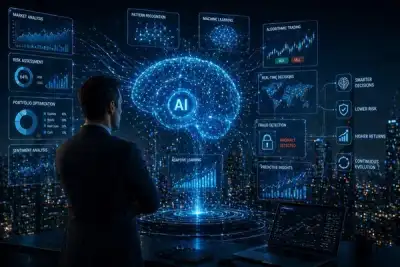
A new “intelligence layer” is emerging within financial systems—powered by artificial intelligence, real-time data, and adaptive infrastructure. This layer is not just improving how finance works; it is redefining it from the inside out.
And while it operates quietly, its impact is becoming impossible to ignore.
From Digital Finance to Intelligent Finance
The first wave of financial technology focused on digitization—moving services online and improving accessibility.
The next wave is about intelligence.
Financial systems are no longer just digital—they are becoming capable of analyzing, learning, and adapting. AI is transitioning from a supporting role to a central force in decision-making and operations. In fact, 2026 is widely seen as the year when AI moves from experimentation to enterprise-wide deployment across financial services ( Finastra ).
This shift changes the nature of finance itself.
Systems can now:
Interpret data in real time
Anticipate risks and opportunities
Adjust strategies dynamically
Finance is no longer static. It is becoming self-improving.
AI Is Redefining How Decisions Are Made
Artificial intelligence is quickly becoming the core decision engine of financial institutions.
From fraud detection to credit scoring and investment strategies, AI is embedded across critical processes. It is not just automating tasks—it is transforming how decisions are made.
Industry trends show that AI agents are increasingly capable of handling entire workflows, from compliance checks to portfolio management ( Forbes ).
This evolution introduces a new dynamic:
Decisions are faster
Insights are deeper
Processes are more efficient
But it also raises important questions about governance, transparency, and oversight.
As systems become more autonomous, the challenge is ensuring that they remain aligned with human judgment and regulatory standards.
Real-Time Finance Is Becoming the Default
One of the most profound shifts in financial technology is the move toward real-time systems.
Financial processes that once relied on delays—batch processing, settlement cycles, and manual verification—are now happening instantly.
Real-time payments, automated reconciliation, and continuous risk monitoring are becoming standard features of modern financial systems ( Innowise ).
This shift has far-reaching implications:
Customers expect immediate transactions
Businesses expect instant financial visibility
Institutions must respond to risks in real time
Speed is no longer a competitive advantage.
It is the baseline for participation in the financial system.
The Rise of Autonomous Finance
Perhaps the most intriguing development is the emergence of autonomous financial systems.
AI is evolving from assisting humans to acting independently within defined parameters. These systems can:
Approve transactions
Detect anomalies
Trigger actions automatically
This concept—often referred to as “agentic AI”—is already influencing financial operations and is expected to become more widespread in the coming years ( Innowise ).
In this environment, finance begins to operate continuously, without waiting for human input.
It becomes:
Always active
Always learning
Always adjusting
This marks a fundamental shift in how financial systems function.
Embedded Finance Is Making Technology Invisible
As financial systems become more advanced, they are also becoming less visible.
Embedded finance is integrating financial services directly into everyday platforms—apps, marketplaces, and digital ecosystems. Instead of accessing financial services separately, users experience them as part of their daily activities.
This means:
Payments happen seamlessly within apps
Credit is offered at the point of need
Financial services become part of user experiences
Embedded finance is no longer just about convenience—it is about integration.
Finance is no longer a destination. It is becoming a background function.
Data Is Becoming the Most Valuable Asset
At the center of this transformation is data.
Every transaction, interaction, and decision generates data. Financial institutions are leveraging this data to:
Predict customer behavior
Optimize operations
Improve risk management
The ability to process and act on data in real time is becoming one of the most important competitive advantages.
But with this comes responsibility.
Data must be:
Secure
Accurate
Used ethically
As finance becomes more data-driven, trust becomes more critical than ever.
Infrastructure Is the Real Revolution
While AI and digital services attract attention, the real transformation is happening at the infrastructure level.
Financial institutions are moving away from legacy systems toward modern, cloud-based architectures that support:
Real-time processing
AI-driven analytics
Scalable operations
This shift is essential for enabling innovation.
According to industry analysis, financial institutions are racing to modernize their core systems while maintaining trust and stability in their operations ( KPMG ).
Infrastructure may not be visible—but it determines everything else.
Competition Is Expanding Beyond Traditional Boundaries
Technology is also reshaping the competitive landscape.
Banks are no longer competing only with other banks. They are competing with:
Fintech startups
Technology companies
Digital ecosystems
These new players are often faster, more agile, and more focused on user experience.
As a result, competition is intensifying.
Institutions must continuously innovate—not just to grow, but to remain relevant.
Risk Is Becoming More Interconnected
As financial systems become more advanced, risk is evolving.
Traditional risks—such as credit and market risk—are now joined by new challenges:
Cybersecurity threats
Algorithmic bias
Systemic interdependencies
These risks are often interconnected.
A disruption in one area can have ripple effects across the entire system.
This requires a new approach to risk management—one that focuses on understanding systems as a whole, rather than individual components.
The Human Role Is Changing—But Not Disappearing
Despite rapid technological advancement, the human element remains central.
AI can process data and generate insights, but it cannot replace:
Judgment
Context
Ethical reasoning
The future of finance lies in collaboration.
Machines handle data and automation. Humans provide insight and oversight.
This partnership ensures that financial systems remain both efficient and responsible.
A System Becoming Smarter, Faster, and More Adaptive
Taken together, these changes point to a financial system that is:
Smarter, through AI and advanced analytics
Faster, through real-time processing
More adaptive, through continuous learning
This transformation is not happening in isolation.
It is influencing:
How businesses access capital
How consumers interact with money
How institutions manage risk
And it is happening quietly—without dramatic disruption.
Why This Shift Matters
The significance of this transformation lies in its depth.
It does not simply improve existing systems—it changes how they function.
It redefines:
Decision-making
Customer experience
Competitive dynamics
And because it happens gradually, it is easy to overlook.
But over time, these changes accumulate—creating a financial system that is fundamentally different from what came before.
Final Thoughts: The Intelligence You Don’t See
The most important technological revolutions are not always visible.
They do not arrive suddenly. They do not always make headlines.
Instead, they integrate quietly—into systems, processes, and everyday experiences.
Today’s financial world reflects this reality:
Invisible, yet powerful
Complex, yet seamless
Evolving, yet already present
And perhaps the most important insight is this:
The future of finance is not being built on what we see.
It is being built on what works silently behind every transaction—shaping decisions, driving systems, and quietly redefining the world of finance.