Technology in finance is often associated with visible innovation—mobile banking apps, digital wallets, or online trading platforms. These are the features customers interact with every day. But the most important transformation happening today is not on the surface.
Technology in finance is often associated with visible innovation—mobile banking apps, digital wallets, or online trading platforms. These are the features customers interact with every day. But the most important transformation happening today is not on the surface.
It is happening underneath.
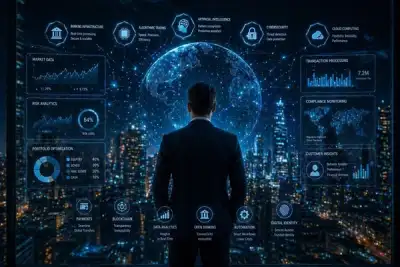
A new technological layer—built on artificial intelligence, real-time data systems, and embedded infrastructure—is quietly rewriting how financial systems operate. It is not flashy. It is not always visible. Yet, it is reshaping the entire financial ecosystem.
And once understood, it changes how we think about the future of banking and finance.
From Tools to Infrastructure
For years, technology in finance was seen as a set of tools—supporting existing systems and improving efficiency.
Today, it has become infrastructure.
Artificial intelligence, cloud computing, and data platforms are no longer optional enhancements. They are now the foundation on which financial systems operate. In fact, AI has moved from experimental use to enterprise-wide deployment, transforming everything from payments to risk management ( Finastra ).
This shift matters because infrastructure is not easily replaced.
When technology becomes foundational, it does not just improve processes—it defines how they work.
The Rise of Real-Time Finance
One of the most important developments in this new layer is the move toward real-time systems.
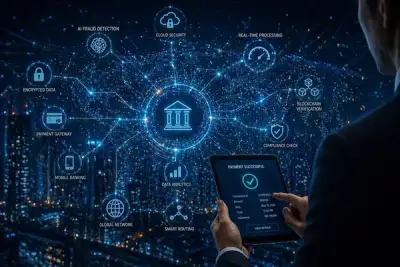
Financial transactions, once processed in batches, are now happening instantly. Payments, fraud detection, and risk assessments are increasingly handled in real time, allowing institutions to respond immediately to changing conditions.
Modern financial infrastructure relies on streaming data and event-driven systems that process transactions continuously rather than periodically ( MHO Blog ).
This creates a new standard:
Customers expect instant payments
Businesses expect real-time financial visibility
Institutions must operate without delay
Speed is no longer a competitive advantage—it is a requirement.
AI Is Becoming the Core Engine
Artificial intelligence is at the center of this transformation.
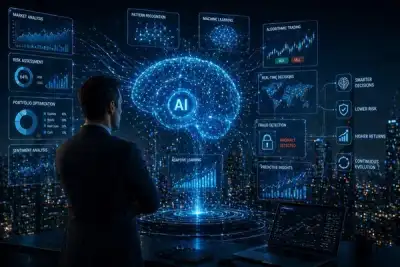
Banks are embedding AI into nearly every aspect of their operations—from customer service and compliance to fraud detection and portfolio management. What was once a backend tool is now a core engine driving decision-making.
Industry analysis shows that AI is increasingly used to analyze vast amounts of financial data in real time, enabling faster insights, improved risk detection, and predictive decision-making ( MHO Blog ).
At the same time, AI is evolving beyond automation.
It is becoming:
Predictive rather than reactive
Proactive rather than supportive
Integrated rather than isolated
This shift is turning financial systems into intelligent systems—capable of learning, adapting, and improving over time.
The Emergence of “Smart Money”
Another major shift is happening at the level of money itself.
Traditionally, money has been passive—a medium of exchange, a store of value. But new technologies are making it more dynamic.
The concept of “smart money” is emerging, where transactions can be automated, optimized, and even programmed based on specific conditions. This includes digital currencies, tokenized assets, and programmable payments.
According to industry research, future financial systems may allow money to execute instructions automatically, optimizing transactions and liquidity without direct human input ( Accenture ).
This represents a fundamental change: Money is no longer just transferred—it is activated.
Embedded Finance Is Changing Access
One of the most subtle—but powerful—trends is the rise of embedded finance.
Financial services are no longer confined to banks or financial institutions. They are being integrated directly into everyday platforms—e-commerce sites, apps, and digital ecosystems.
This means:
Payments happen within platforms
Lending is offered at the point of need
Financial services become part of the user experience
Open finance and API-driven systems are enabling this shift, allowing businesses to embed financial capabilities into their operations seamlessly ( MHO Blog ).
As a result, finance is becoming less visible—but more accessible.
Data Is Becoming the New Currency
If money is becoming smarter, data is becoming more valuable.
Every transaction, interaction, and decision generates data. Financial institutions are using this data to:
Understand customer behavior
Improve services
Predict market trends
The ability to analyze and act on data in real time is becoming one of the most important capabilities in finance.
At the same time, this raises new challenges around:
Data security
Privacy
Ethical use
The value of data is clear—but so is the responsibility that comes with it.
The Pressure to Modernize
As technology evolves, financial institutions are under increasing pressure to modernize.
Legacy systems—once the backbone of banking—are becoming a limitation. They are slower, less flexible, and harder to integrate with modern technologies.
Industry insights show that banks are racing to modernize their core systems, balancing speed with the need to maintain trust, compliance, and operational stability ( KPMG ).
This creates a difficult challenge:
Move too slowly, and risk falling behind
Move too quickly, and risk instability
The future belongs to those who can balance both.
The Changing Nature of Competition
Technology is also reshaping competition.
Banks are no longer competing only with each other. They are competing with:
Fintech startups
Technology companies
Digital platforms
These new players are often faster, more agile, and more focused on user experience.
As a result, traditional institutions must adapt—not just to survive, but to remain relevant.
The competition is no longer about size—it is about adaptability.
Security and Trust in a Digital World
As financial systems become more digital, security becomes more critical.
Real-time transactions, AI-driven systems, and interconnected platforms create new vulnerabilities. Cybersecurity is no longer a technical issue—it is a fundamental requirement for maintaining trust.
At the same time, trust remains the foundation of finance.
No matter how advanced technology becomes, financial systems must be:
Reliable
Transparent
Secure
Without trust, innovation cannot succeed.
The Human Element Still Matters
Despite all the technological advancements, finance remains deeply human.
Decisions about investment, risk, and strategy still rely on judgment and experience.
Technology can enhance decision-making—but it cannot replace human insight.
In fact, the most effective systems combine:
Human expertise
Technological capability
This balance ensures that innovation remains aligned with real-world needs.
A System Becoming Faster, Smarter, and More Connected
Taken together, these trends point to a financial system that is:
Faster, through real-time processing
Smarter, through AI and data
More connected, through embedded systems
This transformation is not happening in isolation.
It is affecting:
Businesses accessing capital
Consumers managing finances
Institutions navigating risk
And it is doing so quietly—without dramatic disruption.
Why This Matters More Than It Seems
The significance of this technological shift lies in its subtlety.
It does not replace the financial system—it transforms it from within.
This makes it easy to overlook.
But over time, these changes accumulate, creating a system that is fundamentally different from what came before.
Final Thoughts: The Future Hidden in Plain Sight
The future of finance is not something that will arrive suddenly.
It is already here—embedded in systems, processes, and technologies that operate quietly in the background.
This invisible layer is:
Making finance faster
Making it smarter
Making it more integrated into daily life
And perhaps the most important insight is this:
The biggest technological shifts are not always the ones we see.
They are the ones we use—every day—without even realizing they are there.