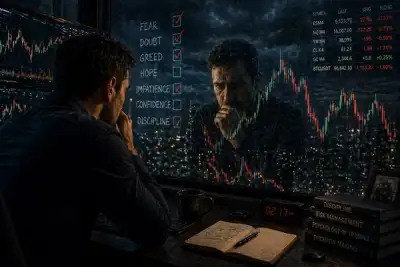
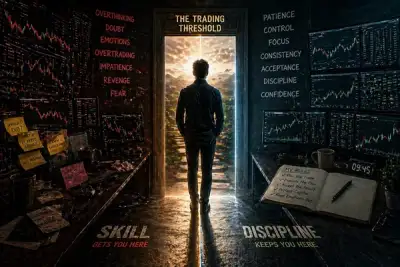
In trading, attention is everything.
Charts, indicators, news, price levels—these are where focus naturally goes. Traders train themselves to observe patterns, identify signals, and react quickly.
But there is a deeper question that rarely gets asked:
What are you not noticing?
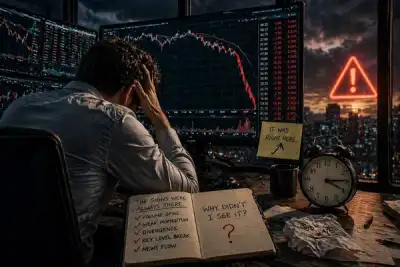
Because in many cases, the difference between consistent performance and repeated mistakes lies not in what traders see—but in what they overlook.
The Illusion of Complete Awareness
Modern trading environments create a powerful sense of awareness.
With real-time data, advanced tools, and constant updates, it feels as though nothing is being missed.
But this sense of awareness is often incomplete.
Human attention is limited. Even in data-rich environments, individuals can only process a fraction of available information.
Behavioral finance research shows that cognitive limitations and biases influence how traders process information, often leading to systematic blind spots in decision-making ( Allied Business Academies )
This means that even experienced traders can miss critical signals—not because they lack knowledge, but because attention is selective.
Why the Obvious Isn’t Always Seen
One of the most surprising realities in trading is that important signals are often visible—but unnoticed.
This happens for several reasons:
Familiarity bias: Traders focus on patterns they recognize
Expectation bias: Traders see what they expect to see
Information overload: Too much data reduces clarity
When multiple signals compete for attention, the brain filters information—often prioritizing what aligns with existing beliefs.
As behavioral studies show, confirmation bias leads individuals to favor information that supports their views while ignoring conflicting evidence ( ijrar.org )
In trading, this can mean missing opportunities—or risks—that don’t fit expectations.
The Role of Mental Shortcuts
To handle complexity, the brain relies on shortcuts—known as heuristics.
These shortcuts help process information quickly, but they come with trade-offs.
In trading, heuristics can lead to:
Oversimplified conclusions
Misinterpretation of signals
Overconfidence in decisions
Behavioral finance highlights that these cognitive shortcuts are essential for speed—but can lead to consistent errors in judgment ( Rajeev Gandhi College )
This is where blind spots begin.
The Hidden Impact of Routine Thinking
Experience improves trading—but it can also create patterns in thinking.
Over time, traders develop routines:
Recognizing familiar setups
Reacting to common patterns
Applying learned responses
While this builds efficiency, it can also reduce awareness.
Traders may:
Ignore unfamiliar signals
Overlook subtle changes in market behavior
Rely too heavily on past experience
This creates a paradox:
The more experienced you become, the easier it is to overlook what doesn’t fit your expectations.
Markets Change Faster Than Perception
Markets evolve continuously.
New participants, new technologies, and changing conditions reshape behavior.
But perception often lags behind.
Traders may continue to interpret markets based on:
Past conditions
Previous strategies
Established patterns
This delay creates blind spots.
Signals that reflect new conditions may go unnoticed because they do not match existing mental models.
The Noise Problem
Another source of blind spots is noise.
Markets generate constant fluctuations—many of which are irrelevant.
Distinguishing between noise and meaningful signals is one of the most difficult aspects of trading.
Too much focus on noise can lead to:
Overtrading
Misinterpretation
Emotional reactions
Too little attention to detail can lead to missed opportunities.
The challenge is balance.
Awareness vs. Attention
It is important to distinguish between awareness and attention.
Awareness is knowing what exists
Attention is focusing on what matters
Trading requires both.
But attention is limited.
This means that improving trading is not just about gaining more information—but about directing attention more effectively.
How Blind Spots Affect Decisions
Blind spots influence decisions in subtle ways.
They can lead to:
Entering trades too late
Ignoring early warning signs
Misjudging risk
Overestimating confidence
Because these effects are not always obvious, they are difficult to detect.
Over time, however, they shape performance.
Developing Better Awareness
Improving awareness in trading is not about adding more tools.
It is about refining perception.
This involves:
Questioning assumptions
Reviewing decisions critically
Identifying patterns in behavior
Staying open to new interpretations
These practices help uncover blind spots.
The Role of Reflection
Reflection is one of the most effective ways to reduce blind spots.
Between trades, traders can evaluate:
What was noticed
What was missed
How decisions were made
Over time, this process reveals patterns.
And those patterns provide insight.
Seeing What Was Always There
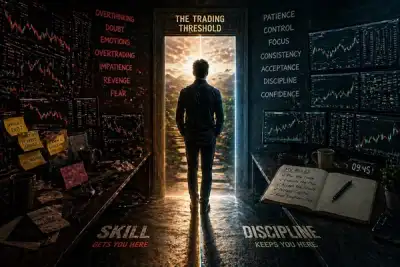
The trading blind spot is not a flaw—it is a natural consequence of human perception.
But recognizing it changes everything.
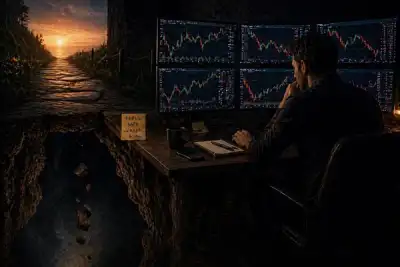
Because once you begin to question what you are not seeing, your perspective shifts.
And in trading:
The difference between missing a signal and acting on it is often not knowledge—
but awareness.